A free sample essay — no signup required
Justice
Broadly speaking, to define a concept, we need to approach it from two different angles: the dialectical and the horistical.
Defining is primarily the domain of philosophers. However, nowadays, philosophers—or those who claim to be philosophers—do not define. It does not even occur to them that defining falls squarely within the domain of philosophy. This isn't unique to any one field, and it isn't unique to artificial intelligence either, as I'll show below. Plenty of people who have spent entire careers around a concept never actually pin it down, and few notice, because fluency is mistaken for understanding.
Now, what do academics who cannot define really contribute to philosophy, if anything at all?
OK, they cannot define because no one told them that it was important. But what is the subject matter of philosophy? What did their teachers tell them?
I would argue that the subject matter of philosophy is knowledge—not language, not logic, and not argumentation as such.
Of course, "subject," "matter," "subject matter," "philosophy," "knowledge," "language," "logic," and "argumentation" all have their own definitions.
Let us see the difference that defining makes by examining the concept of Justice.
I asked one AI for the definition of justice and I got this:
Justice is the principle of giving each person what they are due, according to a relevant and impartial standard.
I asked another, and I got this:
Justice is the principle of moral rightness, fairness, and giving every individual their due.
Both AIs copied Polemarchus in Book I of Plato's Republic: Polemarchus attributes to Simonides the view that justice consists in giving each person what is due to them (331e).
Of course, Socrates proved Polemarchus wrong.
But who, then, decides what each person is due—and on what basis?
For the same crime, let us say high treason, Court X decides that John Doe is due the death penalty; Court Y decides that he is due 20 years in prison; and in the country that benefited from his actions, he is due a medal of honor.
But the crime is identical, which means that this statement does not amount to a definition.
Not every statement qualifies as a definition.
- Definitions always begin with the concept being defined + "is/are."
- A definition must provide a yardstick for determining whether the term applies.
- A definition does not allow for discrepancies of any kind.
These are three of the most basic prerequisites for any definition, but there are others.
Of course, the concept of definition has its own definition.
So, the definitions AI provided are not definitions at all. They are fluent. They use the right vocabulary—"principle," "standard," "moral rightness." A reader skimming quickly might not even notice anything is wrong. And yet, as the court example shows, they collapse the instant a single real case is applied to them. That is what sterile definition looks like: the ability to produce something that sounds like understanding while carrying none of the precision that would let it survive contact with a genuine counterexample.
That is the fate I do not want for my students—sounding like they understand a concept, without the concept actually being pinned down.
Justice is the prevention of crime. (horistical definition)
That means that once a crime has been committed, it is too late for justice; justice can no longer be done.
It also follows from the definition that the penalty for breaking the law is not the law itself. What we today call law enforcement is therefore, strictly speaking, penalty enforcement.
The law says that theft is not allowed. If theft occurs, then justice has been violated, and the only thing that remains is to enforce the penalty for that violation.
At the deepest level, formulating a definition resembles a roulette table. The ball bounces from slot to slot, and so does the concept to be defined: it bounces from node to node, from one logic tree to another logic tree and then to another node altogether, until it finally comes to rest in its appropriate horistical slot.
The great difference between roulette and the horistical methodology, though, is that horistics is neither random nor rigged.
But this is Horistics 101, and we have to leave this for later.
- Now, the horistical definition of Justice shifts from penalty enforcement (pseudo law enforcement) to actual law enforcement.
- The horistical definition makes Justice readily identifiable and measurable: when crime occurs, there is no Justice.
- Justice truly promotes quality of life.
- Citizens have a very concrete logical filter for determining whether the rule of law reigns, rather than the rule of the penalty for breaking the law.
- The government's accountability cannot be evaded or avoided behind meaningless statistics and rhetoric.
- Now, citizens recognize that even everyday language reflects this confusion—when the news reports that someone was "tried and sentenced" and calls it "justice being done," the two ideas have been so thoroughly conflated that no one questions the phrase.
- Now, citizens know that punishment, revenge, financial compensation, war, and what is legal have nothing to do with Justice.
- Now, citizens also know that it is not at all uncommon for the legal to be unjust, and vice versa.
- Now, citizens recognize that crime and punishment is just another industry immersed in unspoken corruption that swallows enormous amounts of economic resources, most of which end up in the offshore banking accounts of those in power.
- Now, society and the academic community can work together to determine what exactly leads people to commit a crime and invest those economic resources in eliminating those conditions.
And, of course, we could enumerate many more benefits.
Living in a society where the law is enforced, like Denmark, is very different from living in a society where the penalty is enforced, like the USA and the overwhelming majority of countries.
Ignorance, then, is the source of the problem philosophy is meant to address, and defining is the threshold of knowledge. Using the name of a concept without knowing its meaning is not knowledge of the concept.
The world has underestimated the value of Socrates' dialectics and horistics at great cost. Today, that is more evident than ever and more needed than ever.
Not every student definition fits a pattern covered here. Get in touch if your teachers need help evaluating one.
From the author
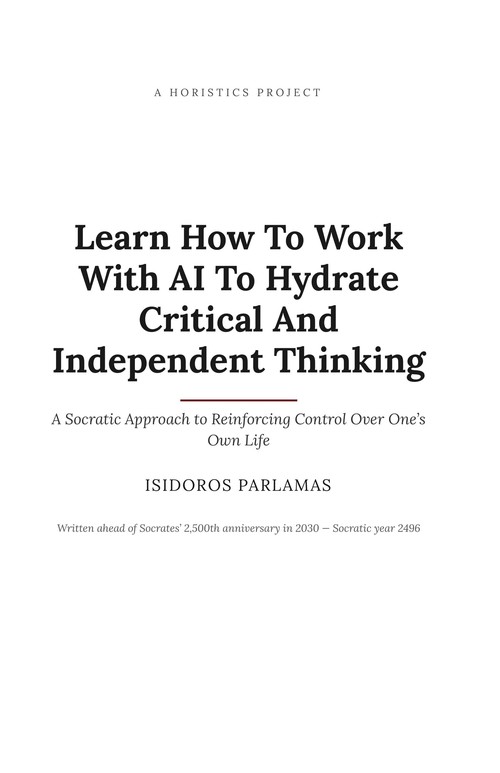
Learn How To Work With AI To Hydrate Critical And Independent Thinking
A Socratic Approach to Reinforcing Control Over One's Own Life
Get it on Amazon — Kindle, paperback & hardcover